
AI in customer service is often framed around the headline-grabbing possibilities: autonomous agents, predictive personalisation, and real-time sentiment analysis.
But some of the most immediate and measurable value unlocked by generative AI right now has nothing to do with these.
It comes from fixing something far more mundane: the simple tasks that should take seconds to complete instead of taking twenty minutes.|
The Trivial Task Problem
Consider a customer who wants to update their mobile number. It is not a complicated request. It does not require specialist knowledge, regulatory approval, or human judgement.
By any measure, it is one of the most routine account management tasks an organisation handles.
And yet, for millions of customers across telecommunications, retail, financial services, healthcare, entertainment and education, this task ends in frustration.
The customer navigates to the self-service portal. They encounter a form that rejects their input, a syntax requirement that was never explained, or an internal system error with no useful message.
They try again. They fail again. With no AI to intercept the moment, they do what customers always do when digital channels let them down: they call.
A contact centre agent picks up. They ask for verification. They walk the customer through the exact same steps the portal requires.
Five, ten, sometimes fifteen minutes later, the mobile number is updated. The customer is mildly relieved but quietly annoyed. The team member moves on to the next call.

This interaction happens thousands of times a day across organisations worldwide.
Password resets. Address changes. Plan modifications. Billing queries. Appointment reschedules. Refunds.
Each one is low-complexity, high-volume, and entirely preventable.
Why This Matters at Scale
The individual interaction is manageable. The aggregate is not.
Contact centre volume data consistently shows that he majority of inbound queries fall into a small number of repeating categories, most of which require no specialist knowledge to resolve.
Organisations staff, train, and pay for teams to handle them regardless.
The cost is not only financial. Every minute spent guiding a customer through a mobile number update is a minute not spent on a complex claim, a distressed customer, or a situation where human empathy actually changes the outcome.
Trivial task volume crowds out high-value work.
We should also consider customer experience costs. A customer who fails twice on a self-service portal and then waits in a queue to speak to a customer service representative has not had a neutral experience.
They have had a bad one.
And research is consistent on this point: customers who experience friction are less likely to stay, less likely to advocate, and more likely to escalate.
What Gen AI Changes
Generative AI does not just assist with this class of problems It resolves it.
A customer who wants to update their details can now simply ask. The AI agent receives the request, confirms the customer's identity, and processes the update.
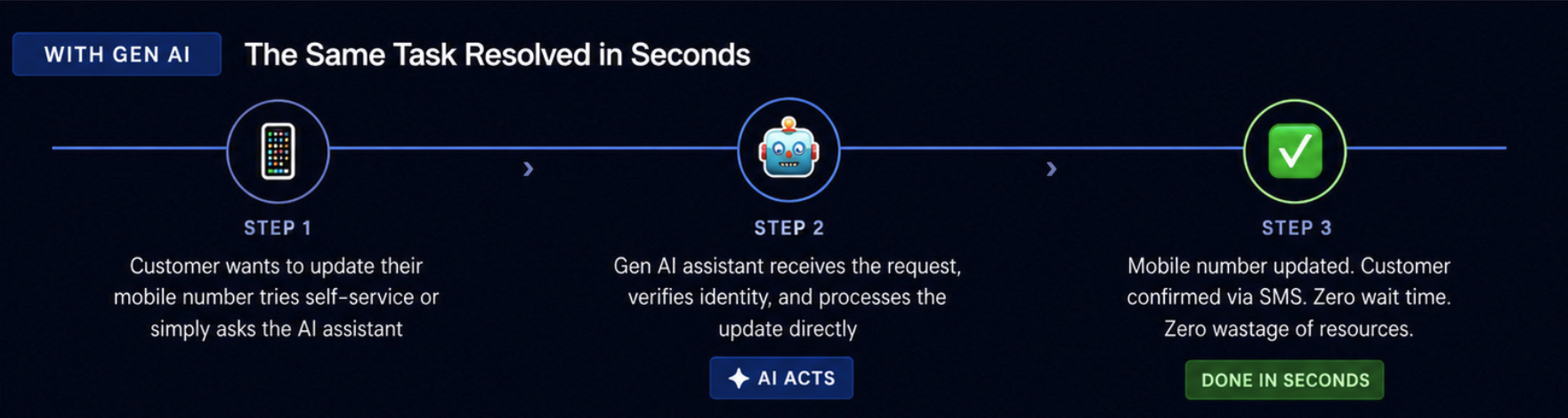
The entire interaction takes seconds. No queue. No frustration. No escalation.
This is not a future capability. It is available now, and Australian organisations that have deployed it are already seeing the impact across contact centre volumes, average handling times, and customer satisfaction scores.
The shift is meaningful for customers and it's transformative for operations.
The Australian Context
Australian organisations operate in a market where customer expectations are rising while labour costs remain significant.
Gen AI does not replace that workforce. It reorients it. By absorbing the high-volume, low-complexity layer of customer contact, AI creates the conditions for customer service representatives to do work that is more meaningful, more skilled, and more commercially valuable.
We at Clevertar, specialise in intelligent customer engagement and have worked with organisations across sectors to deploy exactly this kind of capability. Whether it be financial services, healthcare, education, telecommunications or retail, the opportunity is immense.
The Question Worth Asking
For any organisation still routing simple account management queries through a human contact centre by default, the question is not whether gen AI could handle them. It clearly can.
The question is what it is costing, in time, in customer experience, and in the opportunity cost of deploying skilled people on repetitive trivial tasks.
The technology to change that is no longer emerging. It is here, it is proven, and in the Global market.