
There's a version of the AI story that enterprises love to tell: the bold transformation, the rapid deployment, the headline metrics.
And then there's the version that doesn't make it into the press release - the pilot that quietly stalled, the governance gap that became a compliance incident, the customer trust that eroded because a chatbot said something it shouldn't have.
Both versions are real.
The pressure to move quickly on AI has never been greater. But at Clevertar, we've seen what happens when speed outpaces accountability, and we've also seen what's possible when organisations get the balance right. The enterprises winning with AI right now aren't necessarily moving faster than everyone else. They're moving smarter.
The Adoption Surge Is Real, But So Is the Governance Gap
The numbers on AI adoption are genuinely staggering. McKinsey's 2025 State of AI survey found that 88% of organisations now use AI in at least one business function.
Deloitte's 2026 report found that worker access to AI rose by 50% in 2025 alone, with the number of companies running 40% or more of their AI projects in production expected to double within six months.
This is not hype. This is mainstream enterprise infrastructure.
But scale without discipline introduces new risks.
McKinsey's data shows that 47% of organisations reported at least one negative AI-related incidents including output inaccuracies, compliance violations, privacy breaches etc.
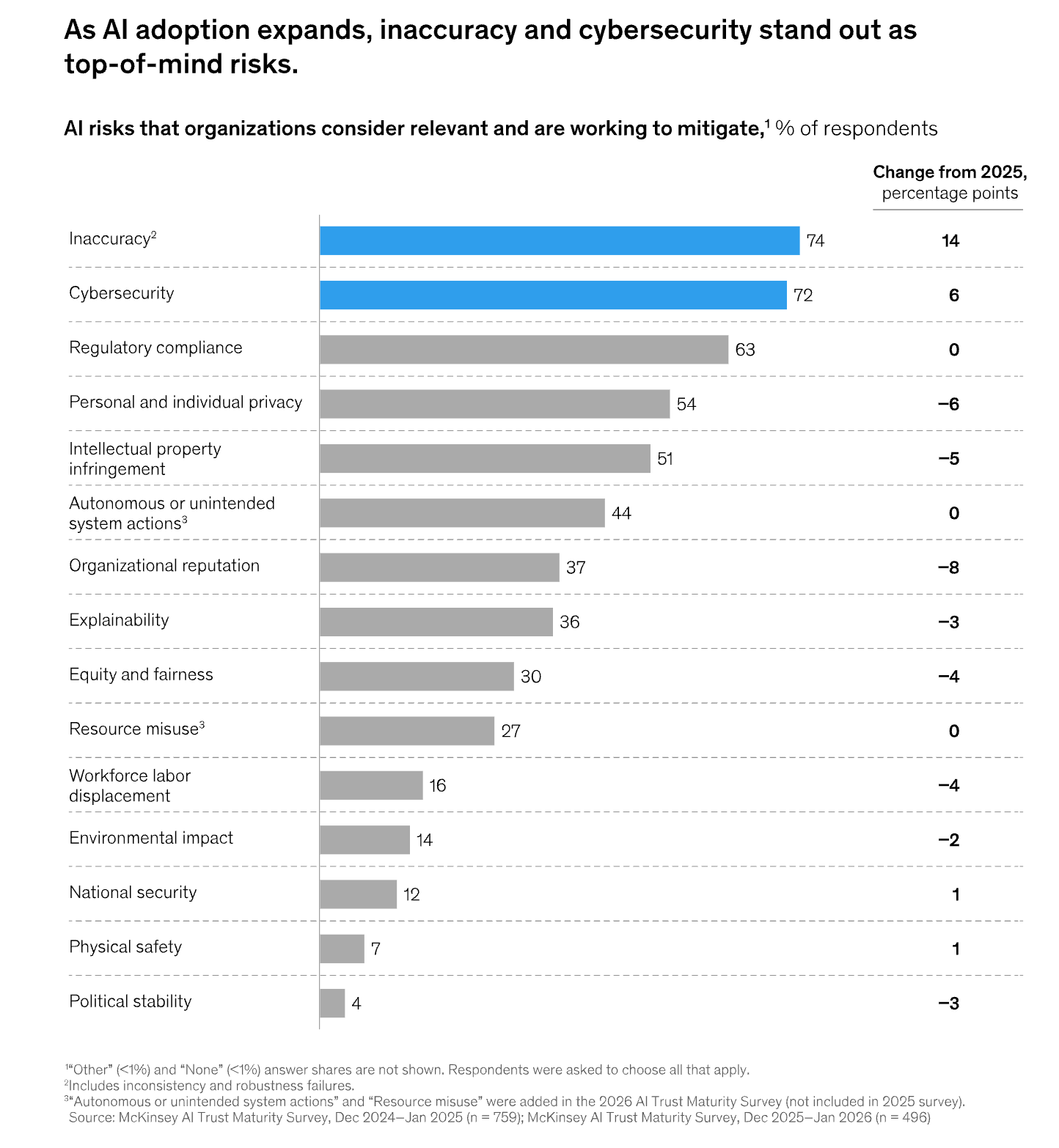
While AI risks span governance, ethics, and operations, organisations are most focused on getting accuracy and cybersecurity right as adoption scales across the enterprise.
Eventhough organisations say they're effective at defining responsible AI priorities, the majority are still struggling with consistency at scale. Governance frameworks exist on paper. The challenge is executing them in practice, at speed, across complex organisations.
The AI ambition is there. The governance infrastructure, for most organisations, is still catching up.
The Trust Problem Is Not a Technical Problem
Here's where most enterprises get it wrong: they treat AI trust as a technical issue to be solved by their IT or risk team. A policy document here, a model review process there, and the problem is considered managed.
It isn't.
McKinsey research found that enterprises where senior leadership actively shapes AI governance achieve significantly greater business value than those delegating oversight to technical teams alone.
True responsible AI adoption isn't a compliance exercise. It's a leadership posture. It requires executives who understand what their AI systems are actually doing, not just what they were designed to do.
We've seen this play out with our own clients. Organisations that approach AI deployment with a clear governance framework from day one don't just avoid problems. They move faster, because their teams have confidence in the systems they're running. They scale with less friction, because trust has been built into the architecture - not bolted on after the fact.
What "Responsible and Fast" Actually Looks Like
The good news is that responsible AI adoption and rapid AI adoption are not in conflict. The organisations doing both well tend to share a few consistent traits.
They start with strategy, not tools. Before selecting a platform or deploying an agent, they define the outcomes they're trying to achieve, the risks they're willing to accept, and the metrics they'll use to measure success.
This is exactly the thinking behind Clevertar's AI Advantage Strategy - a structured sprint that helps executive teams map the fastest, safest path to measurable ROI before a single line of code is written.
They deploy in bounded phases. Design for trust first, speed second. Start with bounded autonomy, and scale only when monitoring shows the system behaves predictably.
This isn't conservatism - it's engineering. Proving value in a contained environment gives organisations the confidence, the data, and the stakeholder buy-in to scale without surprises.
They make oversight everyone's job. The Deloitte 2026 report found that leading organisations embed governance directly into performance frameworks, so that as AI handles more tasks, humans take on active oversight roles.
Accountability doesn't disappear as automation increases - it gets redistributed.
They measure outcomes, not just activity. High-performing organisations track genuine business outcomes - conversion rates, cost reduction, CSAT - not just usage metrics and pilot counts.
The Industries Getting It Right
Not all sectors are starting from the same place. McKinsey's trust maturity data shows that technology, media, and telecommunications firms and financial services lead in responsible AI maturity, partly because they face the most regulatory scrutiny and have the most to lose from governance failures.
In Australia, we're seeing the same pattern. The organisations we work with in government, healthcare, and financial services tend to bring the most rigour to their AI deployments, and they're reaping the rewards.
Their AI systems are more trusted by end users, more resilient to edge cases, and more likely to deliver sustained value over time.
This isn't a coincidence. Organisations operating in high-trust, high-stakes environments have learnt that accountability is not a constraint on innovation - it's a precondition for it.
The Questions Every Executive Should Be Asking
If you're an enterprise leader navigating AI adoption in 2026, the most important questions aren't about which model to use or which platform to buy. They're about governance, accountability, and trust.
- Who is accountable when our AI system makes a mistake?
- Do our customers understand how we're using AI to engage with them?
- Can we audit the decisions our AI systems are making in real time?
- Are we measuring AI impact against business outcomes, or just tracking usage?
- Does our governance model scale as our AI deployment scales?
These questions don't slow you down. They focus you.
Moving Forward Without Moving Recklessly
The era of AI experimentation is over. The question for enterprise leaders in 2026 is not whether to adopt AI - it's whether to adopt it in a way that compounds value over time, or in a way that creates fragility.
At Clevertar, we've spent years working with Australian enterprises across every major industry to help them find the fastest, safest path to AI ROI. The pattern is consistent: the organisations that move with clarity, accountability, and genuine governance don't just avoid the pitfalls. They build the kind of trust - with customers, with employees, with regulators - that becomes a durable competitive advantage.
Speed matters. But trust is what makes speed sustainable.