AI customer service agents have moved quickly from experimentation to boardroom discussion.
The question is whether the investment can be justified commercially. That is where many buying decisions have the potential to go awry.
Some businesses purchase based on features. Others purchase based on fear of being left behind. The stronger approach is more disciplined: calculate the likely return on investment before procurement begins.
This guide walks you through a practical, repeatable framework for calculating the return on investment of an AI customer service agent before you sign anything. No vendor numbers. No marketing benchmarks. Just your own data, run through a methodology that holds up to CFO scrutiny.
The four levers of AI customer service ROI
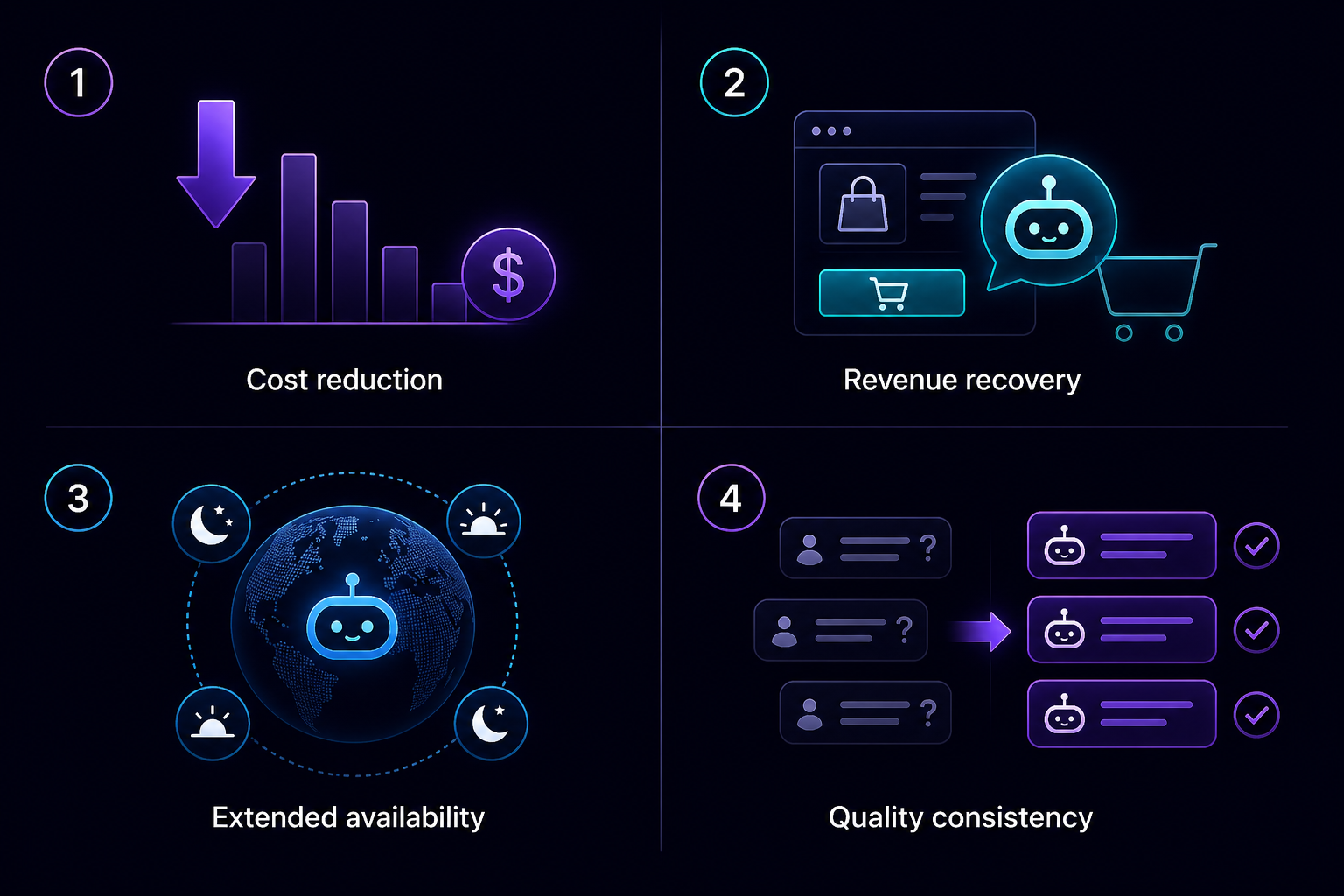
Before running any numbers, it helps to understand the four mechanisms through which an AI agent creates value.
Lever 1: Cost reduction
AI-resolved enquiries reduce the cost-to-serve, either through direct cost reduction over time or by freeing up agent capacity to handle higher-value interactions.
Lever 2: Revenue recovery
AI agents that are deployed on product pages, checkout flows, and search results can intercept the moment a customer hesitates. A well-trained agent can recover a sale that would otherwise be abandoned.
Lever 3: Extended availability
Your team works business hours. An AI agent works every hour of every day. For businesses with international customers, late-night shoppers, or time-sensitive enquiries, after-hours coverage has real commercial value.
Lever 4: Quality consistency
Human agents have good days and bad days. AI agents deliver the same answer to the same question every time. This consistency reduces escalations, complaints, and repeat contacts all of which have measurable benefits.
Step-by-step: building your ROI model
Step 1: Establish your current cost baseline
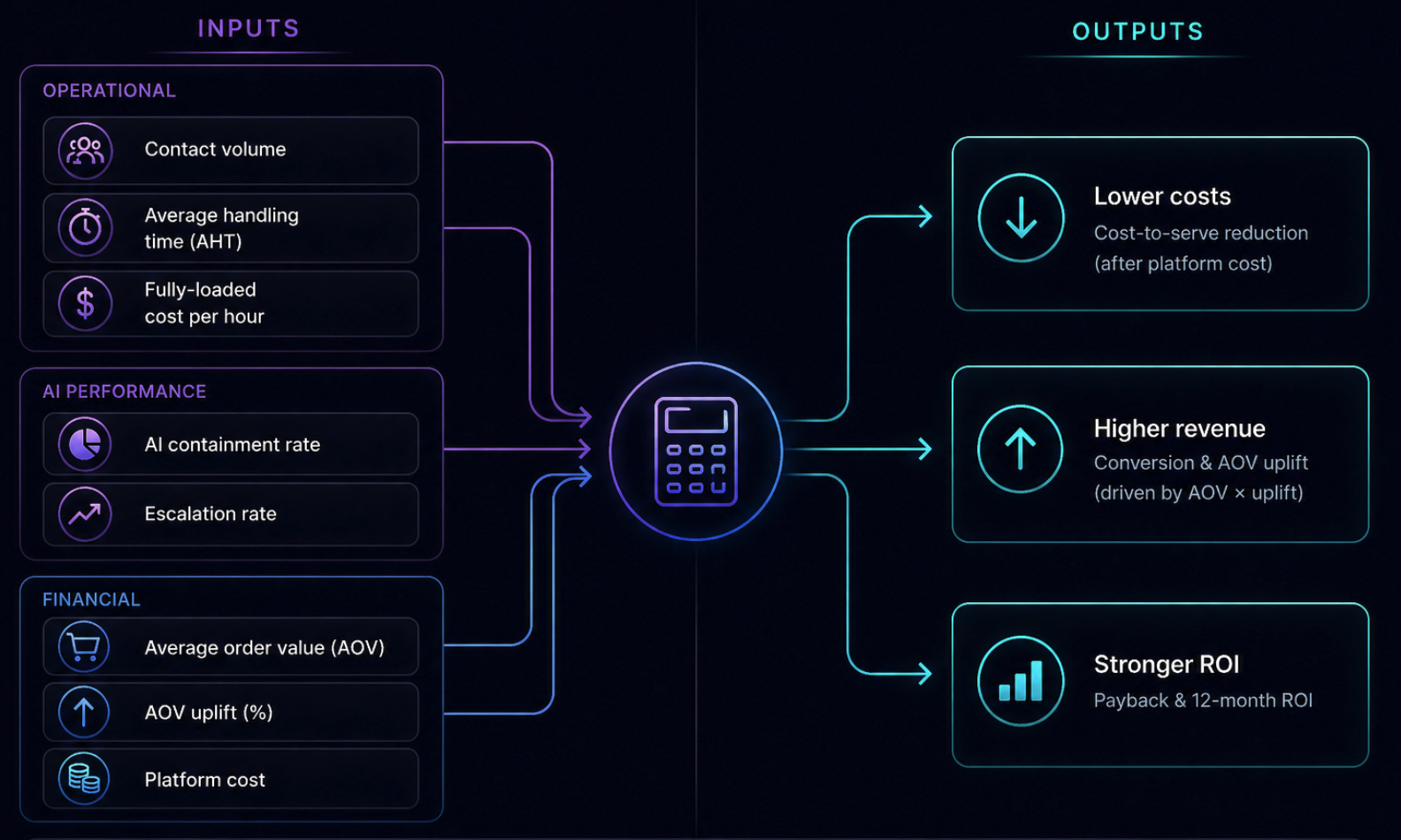
Start by calculating what your customer service operation costs today. You'll need:
- Total contact volume per month - all inbound enquiries across all channels (phone, email, chat, social)
- Average handling time (AHT) - how many minutes a typical enquiry takes from first contact to resolution
- Fully-loaded cost per agent hour
From these numbers you can derive your current cost per contact:
Cost per contact = (AHT in minutes ÷ 60) × fully-loaded hourly rate
For example: an AHT of 8 minutes and a fully-loaded rate of $55/hour gives a cost per contact of $7.33. Multiply this by your monthly contact volume to get your monthly service cost baseline.
Monthly service cost = Cost per contact × Monthly contact volume
Step 2: Identify AI-resolvable contact types
Not all enquiries are suitable for AI resolution. The key is to categorise your contact types and estimate what proportion an AI agent could handle without human intervention. Typically well-suited to AI resolution:
- Order status and tracking enquiries
- Return and refund policy questions
- Product information and comparisons
- Account management (password resets, address updates)
- Appointment bookings and cancellations
- FAQ-type support (opening hours, store locations)
- Basic troubleshooting
Typically requiring human escalation:
- Legal or regulatory queries
- Novel situations outside the training data
- High-value customer relationships requiring relationship management
Across most retail, telco, and services businesses, somewhere between 40% and 70% of contacts fall into AI-resolvable categories.
A conservative starting assumption is 45–50%. Run your analysis at multiple containment rates to understand the sensitivity of your outcome. Containment rate refers to the percentage of enquiries fully resolved by AI without human intervention.
Step 3: Calculate cost-side savings
Once you have an estimated containment rate, the calculation is straightforward. Start by calculating the number of enquiries fully resolved by AI:
AI-resolved contacts = Monthly contacts × containment rate
Not all AI-handled enquiries are fully resolved. A portion will escalate to human agents.A conservative assumption is a 10–20% escalation rate, which should be factored into your containment model. Next, calculate the gross cost impact:
Gross Monthly Saving = AI-resolved contacts × cost per contact
Finally, account for the cost of the AI platform:
Net Monthly Saving = Gross saving - Monthly platform cost
Enterprise AI agent platforms in the Australian market typically priced per conversation, per seat, or as a flat monthly fee. Get a specific quote for a more accurate calculation.
Step 4: Model the revenue upside
AI agents deployed at the point of purchase don't just answer questions, they lift average order value by surfacing complementary products, clarifying options, and keeping customers engaged when they'd otherwise drop off.
To model this impact credibly, revenue uplift should be applied only where transactions occur, not across total traffic. Start by estimating:
- Monthly orders (or conversions) - the number of completed purchases/ successful transactions/ Successful bookings etc.
- Average order value (AOV) - your current baseline
- Estimated uplift from AI intervention - We recommend modelling at a conservative 10 - 15% AOV uplift of your baseline. Clevertar's own case studies have shown uplifts of up to 40%, but 15% is a credible, defensible number.
Revenue uplift can then be calculated as: Revenue uplift = Completed transactions × AOV × Uplift %
This figure is additive to your cost savings and often surprises finance teams with its scale.
Step 5: Factor in implementation costs
Don't project savings without accounting for the full cost of getting there:
- Implementation and configuration fees - setup, integration, knowledge base ingestion
- Internal project time - your team's hours on briefing, testing, and sign-off
- Change management - helping human agents adapt to an AI-assisted workflow and triaging
- Ongoing optimisation - Monthly tuning, content updates, performance reporting
A well-scoped managed implementation typically bundles most of these.
Step 6: Calculate your payback period
With costs and savings modelled, you can now derive two key metrics.
Payback period = Total implementation cost ÷ net monthly saving
12-month ROI = ((12-month net saving + 12-month revenue uplift) − total implementation cost) ÷ total implementation cost × 100
A well-scoped AI agent deployment for a mid-market Australian enterprise typically shows a payback period of 3–5 months and a 12-month ROI of 150–400%, depending heavily on contact volume and containment rate.
Example
A customer service operation handling 5,000 enquiries per month could conservatively reduce cost-to-serve by approximately $9,000–$13,000 per month, while generating an additional $3,000–$6,000 in monthly revenue uplift through improved conversion and customer engagement.
After accounting for a $1,500 monthly platform cost, this results in a net monthly benefit of approximately $10,500–$17,500. Under these assumptions, the investment typically achieves payback within 3–5 months and delivers a 12-month ROI in the range of 150%–300%, depending on containment performance and optimisation maturity.
Limitations & Sensitivity
While this model captures the primary financial drivers, it does not include additional benefits such as time savings, improved customer satisfaction (CSAT), faster resolution times, and productivity gains, which can further strengthen the overall business case.
Outcomes are also dependent on key assumptions such as containment rate, escalation rate, and revenue uplift, which vary by organisation and industry.
To test robustness, the model should be run across a range of scenarios (Scenario and Sensitivity Analysis):
- Containment rate: 40–60%
- Escalation rate: 10–20%
- AOV uplift: 5–15%
A credible case should remain positive under conservative assumptions, with upside scenarios reflecting full commercial potential.
Several platforms are worth evaluating before making a final decision.
Clevertar is a well-established managed-service provider in the Australian market, with deployments across retail, telco, healthcare, education, and government.
Their partnership approach focuses on setup, training, and ongoing optimisation, making them suitable for organisations seeking accountability and sustained performance.
For teams that want a partner focused on outcomes rather than just deployment, Clevertar is a strong option to consider.