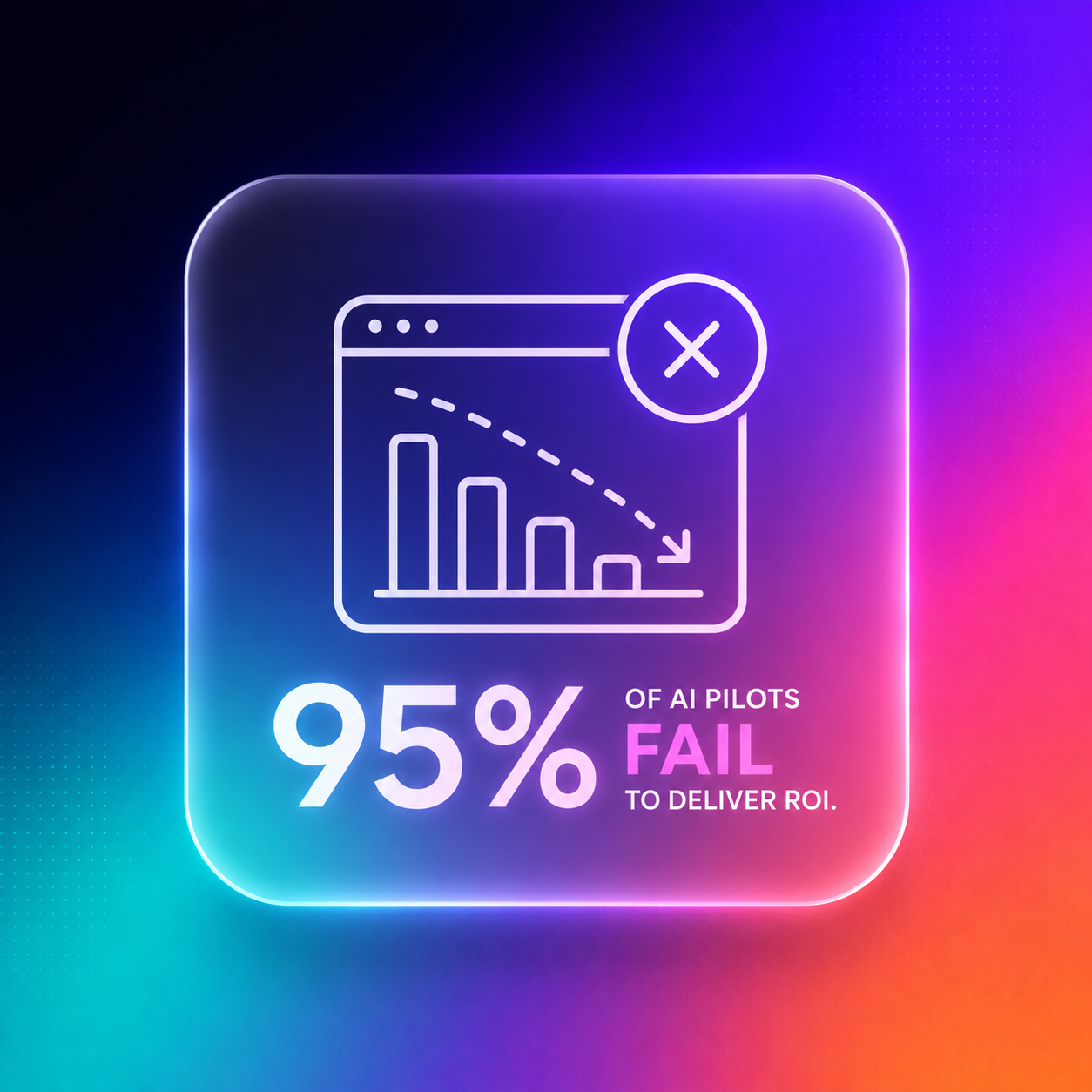
Worldwide AI spending is on track to hit US$2.5 trillion in 2026. Yet according to Gartner, 95% of enterprise AI pilots deliver zero measurable financial return.
Only 39% of technology leaders are confident their current AI investments will improve financial performance.
This is no longer a tooling problem. It is what is now described as the AI Value Crisis, and it is becoming a board-level concern.
Buyers are pushing back on pricing. CFOs are questioning ROI. Customers are sceptical of vague "AI-powered" claims. And technology and services leaders are being asked the same hard question in every quarterly review: where is the value?
At Clevertar, we have spent the last 10 years partnering with Australian enterprises to move past the proof-of-concept theatre and into AI deployments that actually pay.
The pattern is remarkably consistent.
The real reason AI pilots fail
The most expensive AI strategy in 2026 is the one that looks the cheapest on paper.
Buying a model licence, plugging it into a customer-facing channel, and hoping for results is not a strategy. It is a budget line that quietly underperforms until someone asks why.
The result is a system that performs well in isolation, but fails in production.
The DIY trap
In Gartner’s 2026 research, 93% of enterprise AI budgets go to technology.
Only 7% go to the organisational layer: training, change management, governance, enablement, and workflow redesign.
In other words, the pilots that fail are the ones that bought the engine and forgot to build the car.
We see this pattern repeatedly when prospective clients come to us after an internal attempt has stalled.
The model works in demos.
But in production it breaks at the edges: real customer intent, messy inputs, incomplete data, and escalation scenarios that were never designed.
At that point, the problem is no longer technical. It is operational.
What "responsible and profitable" AI actually looks like
Responsible AI is a phrase that gets overused to the point of meaninglessness. We use it deliberately, because in 2026 the responsible path and the profitable path are the same path.
The Australian organisations getting real value from AI right now are doing three things differently.
First, they start with a measurable business outcome, not a technology choice.
Before a single line of code is written, they have agreed what the agent has to achieve, which data sources it needs, and what the success metric looks like to call the deployment a win.
Second, they treat deployment as a managed process, not a launch event.
Our three-phase model, Plan and Configure, Test and Launch, then Optimise and Scale, exists because the failure points are almost always at the seams..
The board does not care that the model is impressive. The board cares that the agent handled 4,000 conversations last week, deflected 62% of them from the call centre, and added 18% to web conversion. That outcome is engineered, not stumbled into.
Third, they keep humans in the loop, by design, not by accident.
The result is consistent: more conversations resolved, fewer support tickets, higher customer satisfaction, and a measurable line on the P&L.
The window is now
You do not need a bigger AI budget or more AI experiments. You need a sharper plan, a trusted partner, and a deployment discipline that has been proven consistently.
Sources
- Gartner, AI Value Crisis: How Tech CEOs Can Scale Outcomes and Restore Trust. https://www.gartner.com/en/articles/ai-value-crisis
- Gartner, How Technology and Services Leaders Can Overcome the AI Value Crisis (webinar). https://www.gartner.com/en/webinar/844827/1853788-how-technology-and-services-leaders-can-overcome-the-ai-value-crisis
- Gartner, Organizations with Successful AI Initiatives Invest Up to Four Times More in Data and Analytics Foundations, April 2026. https://www.gartner.com/en/newsroom/press-releases/2026-04-16-gartner-says-organizations-with-successful-ai-initiatives-invest-up-to-four-times-more-in-data-and-analytics-foundations
- Gartner, AI Projects in I&O Stall Ahead of Meaningful ROI Returns, April 2026. https://www.gartner.com/en/newsroom/press-releases/2026-04-07-gartner-says-artificial-intelligence-projects-in-infrastructure-and-operations-stall-ahead-of-meaningful-roi-returns
- Gartner, Worldwide AI Spending Will Total $2.5 Trillion in 2026. https://www.gartner.com/en/newsroom/press-releases/2026-1-15-gartner-says-worldwide-ai-spending-will-total-2-point-5-trillion-dollars-in-2026